What Makes a Loyalty Reward Feel Worth It to Customers?

Learn what makes a loyalty reward feel valuable to customers, which rewards work best for small businesses, and how to design perks people actually redeem.
What Makes a Loyalty Reward Feel Worth It to Customers?
A loyalty reward only works if customers actually care about it. That sounds obvious, but it is where a lot of small business loyalty programs go wrong. The reward may technically have value, but if it feels slow, boring, confusing, or too small to matter, customers will ignore it.
That is the real question small businesses should ask. Not just “what reward can we offer?” but “what reward feels worth it to the customer in the moment?”
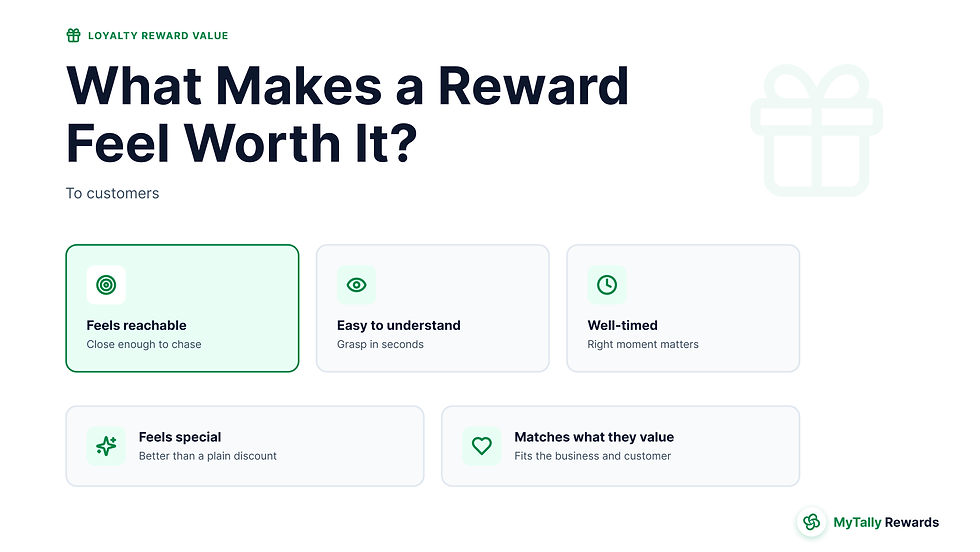
Because that is what drives action. A reward feels worth it when customers can understand it quickly, earn it without losing patience, and enjoy it in a way that feels better than a generic discount. If your reward does that, people come back for it. If it does not, your loyalty program becomes background noise.
Why this matters more than most businesses realize
Many loyalty programs fail quietly. Customers still sign up. Staff still mention the program. Points still exist in the system. But the reward itself does not create enough pull to change behavior.
When that happens, your program may look alive on the surface while underperforming underneath. Customers join, but do not return more often. They earn, but do not redeem. They hear about the reward, but it does not feel exciting enough to act on.
That is why reward design matters so much. A good reward improves engagement, repeat visits, and redemption. A weak reward makes the whole program feel weaker than it really needs to be. If you want to understand the measurement side of that, our guide on what redemption rate is and what it actually tells you shows how low reward appeal usually reveals itself in the numbers.
The first rule: the reward has to feel reachable
A reward can be generous and still fail if it feels too far away. Customers care less about the size of a future perk when they do not believe they will realistically reach it.
This is why the first reward matters so much. If a customer joins today and feels like they are making progress right away, the loyalty program feels alive. If they join and the reward feels like a distant project, the motivation drops fast.
For a café, this usually means the first reward should come within a realistic number of visits. For a salon, it may mean giving credit toward an add-on or upgrade rather than forcing people to wait too long for a large discount. For retail, it may mean a visible milestone instead of a vague pile of points.
This is one reason simple digital loyalty programs often outperform more complicated systems. Customers need to know where they stand. If they can see progress clearly, the reward feels closer. If they cannot, the reward feels abstract. That is part of why our guide on digital loyalty programs vs punch cards matters here. Visibility changes motivation.
The reward has to feel bigger than its actual cost
The best loyalty rewards often cost the business less than they feel worth to the customer. That is where the smartest programs win.
A free pastry with a drink purchase may feel exciting to a café customer even if the hard cost is manageable. A free add-on, priority booking perk, birthday upgrade, or members-only item can feel premium without crushing margins. What matters is not just the raw dollar value. What matters is perceived value.
That is why the strongest loyalty rewards usually fall into one of these categories:
something customers already want
something that feels like a treat
something that feels exclusive
something that saves time or effort
something that feels better than a plain discount
A lot of small businesses make the mistake of defaulting to percentage discounts for everything. But a reward that feels special often outperforms a reward that simply looks mathematical.
Customers need to understand the reward instantly
If customers need a long explanation, the reward is already weaker.
The best loyalty rewards are easy to grasp in a few seconds. Free drink. Free appetizer. Free upgrade. Double points today. Birthday reward. VIP perk. Early access. Customers should not have to do mental math or ask three follow-up questions to understand what they are getting.
This matters at checkout even more than online. In-person businesses move fast. Staff need to explain the program quickly. Customers need to see the value quickly. A reward that is too layered or too conditional usually loses momentum right where it matters most.
That is also why many small businesses get better results from clear visit-based or simple points-based rewards than from overbuilt systems. If you are still working through the basics, our guide on what a customer loyalty program is and why small businesses use one is a good reminder that the best loyalty programs are usually easier to use than owners expect.
Timing changes how valuable a reward feels
A reward can feel weak or powerful depending on when it appears.
A free item after months of inactivity may not mean much. But the same reward offered right when a customer is close to drifting away can bring them back. A bonus perk tied to a birthday, tier milestone, or near-complete punch card can feel much more motivating than the same offer sent at random.
That is because value is not only about the reward itself. It is also about context.
Here are a few moments when rewards tend to feel especially worth it:
right after sign-up, when the customer is deciding whether this program matters
just before the next milestone, when progress feels close
on a slow day, when a small push can bring someone in
during a birthday or anniversary window
when a once-regular customer has started slipping away
That last one is especially important. A smart reward can act like a win-back tool if it shows up at the right time. If you want to think more about that timing, our guide on what churn rate is and how to fix it with loyalty covers why catching that drop-off early matters.
The reward should match the business type
Not every reward works equally well in every business. One reason generic loyalty content struggles is that it treats all rewards like they work the same everywhere. They do not.
For cafés and coffee shops
Customers want rewards that feel fast, familiar, and easy to use. Free drinks, size upgrades, bakery add-ons, and bonus visit days tend to feel worth it because they fit the buying pattern. A $20 future coupon may be less motivating than a free drink that feels close.
For salons and spas
Customers usually care more about upgrades, add-ons, birthday perks, priority booking, or service credits than tiny discounts. A free toner, deep-conditioning add-on, brow add-on, or birthday upgrade often feels more valuable than a flat percentage off.
For restaurants
Customers respond well to rewards that improve the experience of the visit. Free appetizers, members-only specials, points multipliers on quiet nights, and milestone rewards can feel worth it because they make the next meal feel better, not just cheaper.
For local retail
Customers often value early access, better birthday rewards, exclusive items, members-only promotions, and point milestones that feel tied to real purchases. The strongest retail rewards often create a sense of access, not just savings.
This is why our guide on the best loyalty rewards ideas for cafes, salons, and restaurants useful to keep nearby when building your reward menu. Good rewards should match how customers already buy from you.
Why some rewards sound good to owners but not to customers
Business owners sometimes design rewards based on what feels safe to give, not what feels exciting to receive. That usually leads to rewards that are technically fine but emotionally flat.
Here are common examples:
rewards that take too long to earn
tiny percentage discounts that do not change behaviour
rewards customers do not actually want
confusing points systems with unclear value
“exclusive” perks that do not feel exclusive at all
rewards that only help the business, not the customer
This is where loyalty fatigue can start. Customers stop paying attention because the reward menu begins to feel repetitive, low-energy, or disconnected from what they actually care about. If that pattern sounds familiar, our guide on what loyalty fatigue is and the signs your program needs a refresh can help you spot it early.
The best rewards create progress, not just savings
A lot of businesses think the reward itself is everything. But progress matters almost as much as the prize.
Customers like to feel that they are moving toward something. That is why visible progress bars, clear stamp counts, tier movement, and milestone updates can make the same reward feel more valuable. When people can see they are getting closer, they are more likely to come back before momentum fades.
This is also where stronger digital loyalty systems stand out. A paper punch card can show punches, but it does not do much beyond that. A better digital setup can show progress, unlocked rewards, tier status, and timely reminders. That helps the reward stay visible between visits instead of disappearing into a wallet, drawer, or forgotten app.
For in-person businesses, that visibility matters a lot. MyTally does this better than old-school punch cards because customers can keep their loyalty card in Apple Wallet or Google Wallet, see their progress, and use it quickly at checkout without adding another app to their phone. That makes rewards feel more real because customers do not have to remember them from scratch every time.
Exclusive rewards often feel stronger than bigger rewards
Customers do not always want the biggest reward. Often, they want the reward that feels more special.
That is why VIP and tier-based rewards can work so well. Early access, priority booking, members-only offers, birthday perks, or top-tier bonus rewards can create stronger emotional pull than a basic discount because they feel earned.
Exclusivity changes the experience. It tells the customer, “you are not just saving money, you are getting something not everyone gets.”
That is a big reason why our guide on what loyalty tiers are and how they work matters in this conversation. The right tier structure does not just make rewards better. It makes them feel more worth chasing.
And if you are considering that top-end approach, our guide on VIP loyalty programs for small businesses and when they work best breaks down when exclusivity actually helps and when it just adds complexity.
A reward has to fit your margins too
A reward is not worth offering if it damages the business every time someone redeems it. The strongest loyalty rewards balance customer appeal with margin control.
That usually means choosing rewards with high perceived value and manageable cost. It also means thinking about what behavior the reward is supposed to drive. A reward that increases visit frequency may be worth more than one that simply gives away revenue. A reward that lifts average order value may pay for itself faster than one that trains customers to spend less.
That is why reward design should never happen in isolation. You want to think about:
repeat visits
average order value
redemption rate
active member rate
customer lifetime value
If you are trying to connect reward design back to bigger business impact, our guide on what customer lifetime value is and why loyalty matters and our guide on what average order value is and how loyalty programs grow it are the two most useful places to start.
How to tell if your rewards feel worth it right now
If you are unsure whether your current rewards are working, ask a few practical questions:
Do customers mention the reward without being prompted?
Do they seem excited when staff explain it?
Are people redeeming at a healthy rate?
Do rewards bring customers back sooner?
Do top customers engage more deeply with the program?
Can a new customer understand the value in under 10 seconds?
If the answer to most of those is no, the reward probably does not feel worth it yet.
That does not always mean the program is bad. Sometimes it just means the reward menu needs a sharper first milestone, better visibility, clearer messaging, or a stronger match with what your customers actually buy.
What MyTally helps with here
A reward feels more valuable when customers can see it, track it, and use it easily. That sounds simple, but many loyalty platforms make the experience harder than it needs to be.
Some systems are too app-heavy for quick in-person use. Some feel fine at sign-up but weak during everyday checkout. Some make rewards exist in theory more than in practice.
MyTally is better suited to this because it is built for in-person digital loyalty. Customers can join by QR code, keep their loyalty card in Apple Wallet or Google Wallet, and check their rewards and progress without digging through another app. That makes the reward feel present, not hidden. And when a reward feels present, it has a much better chance of feeling worth it.
The bottom line for small businesses
A loyalty reward feels worth it when it is easy to understand, realistic to earn, satisfying to use, and matched to what the customer actually values. It should feel close enough to chase, strong enough to matter, and simple enough to explain in one sentence.
For small businesses, the best rewards are usually not the flashiest ones. They are the ones that fit the buying habit, create visible progress, and make customers feel recognized. When you get that right, your loyalty program stops being just another promotion and starts becoming a real reason to come back.
Sources:
Forbes, Guide To Loyalty Programs For Small Businesses
LoyaltyLion, 9 Loyalty Program Benefits in 2026
Growave, Understanding VIP Loyalty Programs: Benefits and Implementation
Emarsys, 8 Best Tiered Loyalty Program Examples for Customer Retention
myCred, 10 Best Advantages of VIP Loyalty Programs
HappyRewards, Best Loyalty Programs for Small Businesses
MyTally homepage
MyTally product features


Comments