VIP Loyalty Programs for Small Businesses: When They Work Best

Learn when a VIP loyalty program makes sense for a small business, which businesses benefit most, and how to use VIP tiers without making rewards too complicated.
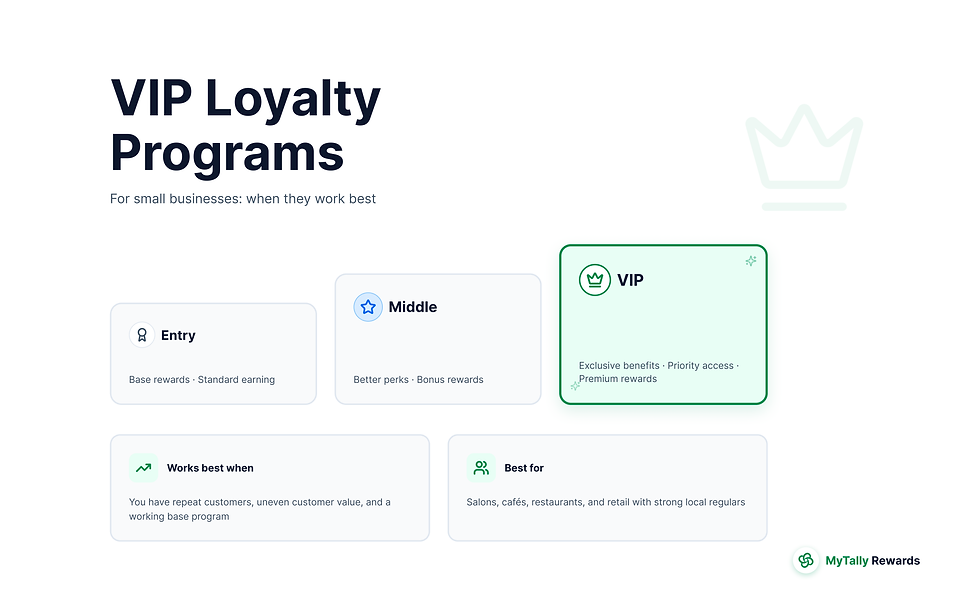
VIP Loyalty Programs for Small Businesses: When They Work Best
A VIP loyalty program is a loyalty setup that gives your best customers better perks than everyone else. Instead of giving every member the exact same reward forever, it creates extra value for customers who spend more, visit more often, or stay engaged for longer.
For the right small business, that can work extremely well. A VIP loyalty program can increase repeat visits, lift average order value, and give regulars a real reason to keep choosing you over nearby competitors. But it is not the right fit for every business, and that is where many owners get it wrong.
Some businesses jump into VIP perks too early, before the basic loyalty program is working. Others make the VIP tier so complicated or so hard to reach that customers stop caring. The goal is not to make your program feel fancy. The goal is to make your best customers feel recognized in a way that also makes business sense.
What a VIP loyalty program actually is
A VIP loyalty program rewards top customers with exclusive perks based on spending, visit frequency, points earned, or overall engagement. In some businesses, that means a higher tier inside a normal loyalty program. In others, it looks more like a members-only club with better benefits, early access, priority booking, or better earn rates.
The key difference is that a VIP program creates levels of value. Everyone may be able to join the loyalty program, but not everyone gets the same treatment forever. The best customers unlock something extra.
That is why VIP loyalty programs often overlap with tiered loyalty. If you have already read our guide on what loyalty tiers are and how they work, you already know the logic. VIP is usually the top layer of that system, where rewards become more exclusive, more personal, or simply more worth chasing.
When VIP loyalty programs work best
VIP loyalty programs work best when a business already has a healthy base of repeat customers and wants to deepen that behavior, not create it from scratch. If customers are still forgetting to come back after their first or second visit, a VIP structure is probably too advanced for where the business is right now.
They also work best when customer value is uneven. If some customers spend two or three times more than others, or visit much more often, a VIP setup can help you recognize and retain those higher-value customers without giving away premium perks to everyone.
In plain terms, a VIP loyalty program tends to make the most sense when all three of these are true:
you already have repeat customers
some customers are clearly more valuable than others
you want to grow retention and spend without relying only on discounts
That is why VIP programs are often a good fit for salons, medspas, boutique fitness studios, cafés with strong regular traffic, restaurants with frequent locals, and neighbourhood retail stores with returning customers who buy across the year.
When a VIP loyalty program does not work well
A VIP program usually does not work well when the business has low purchase frequency and weak customer recognition. If most customers visit once every few months, or only for one-off occasions, a VIP layer may not have enough momentum to matter.
It also struggles when the core loyalty program is already underperforming. If customers are not redeeming rewards, not staying active, or not joining in the first place, adding VIP tiers usually does not solve the real problem. It just adds another layer on top of weak engagement. That is why it helps to first understand our guide on active member rate and how to know if your program is actually working and our guide on repeat purchase rate and why it matters more than sign-ups before adding a VIP structure.
Another common problem is going too premium too fast. A small business does not need to copy Sephora or Nordstrom. If your store only has one location, a simple program customers actually understand will usually outperform a more impressive-looking program that feels hard to follow.
Which small businesses benefit most from VIP loyalty programs
Salons, spas, and medspas
VIP loyalty programs work especially well in beauty and service businesses because customer value often varies a lot. Some clients come in for quick appointments a few times a year. Others book high-ticket services regularly, add products at checkout, and refer friends.
That is a great setup for VIP rewards. You can give better perks to the people already driving the most value without lowering margins across your whole customer base. Priority booking, birthday upgrades, bonus points, free add-ons, and early access to seasonal promos can all make sense here.
This also works because salons and spas already run on relationship strength. If you improve the sense of recognition, you often improve retention too. That is where our guide on what customer retention is and how loyalty drives it becomes useful, because VIP programs tend to work best when they strengthen an existing habit instead of trying to manufacture one.
Cafés and coffee shops
A café can absolutely run a VIP loyalty program, but only if it already has real regulars. If most of your business is walk-in traffic with weak repeat patterns, keep it simple. But if you have customers who come in three, four, or five times a week, VIP can be a smart next layer.
For cafés, VIP perks need to stay light and frequent. Think bonus stamps on slow days, a faster path to free drinks, birthday treats, early access to seasonal menu items, or members-only surprise rewards. The VIP feeling here is not luxury. It is familiarity, convenience, and little moments of recognition.
That is also why wallet-based loyalty works especially well for this kind of business. A digital pass in Apple Wallet or Google Wallet keeps the program visible during the kind of short, repetitive visits that cafés depend on. Compared with paper punch cards or clunky app flows, MyTally keeps the program easier to access and easier to use at the counter.
Restaurants
Restaurants can benefit from VIP programs when they have a dependable local customer base. If people are already choosing your restaurant regularly, a VIP structure can make that choice feel more rewarding.
The best restaurant VIP perks usually focus on access, status, and better visit economics. That could mean priority reservations, a free appetizer after a milestone, bonus points on quieter nights, or special event invites for top members. The goal is to create a reason to come back sooner and spend a little more while doing it.
This is where our guide on what average order value is and how loyalty programs grow it matters, because a good VIP structure should not only increase loyalty. It should also create a path to larger tickets from customers who are already engaged.
Retail stores
VIP loyalty programs can work very well for local retail because customer value often spreads out clearly over time. Some customers buy once during a holiday period. Others come back every season, buy full-price items, and respond to exclusive drops or private sale access.
That makes VIP benefits easier to design. Early access, better point multipliers, members-only sales, exclusive products, and higher-value birthday rewards all fit naturally. The key is to avoid making the benefits feel like generic discounts. Recognition and access often matter more than another small coupon.
This is also where MyTally can have an edge over more standard point tools. Some platforms focus heavily on ecommerce-style loyalty or general points tracking. MyTally is better suited to small in-person businesses that want a digital loyalty program customers can actually use in-store without downloading a separate app, while still letting you create better experiences for top members through tiers, visits, points, and visible reward progress.
The signs you are ready for a VIP loyalty program
If you are wondering whether now is the right time, look for these signs:
a clear group of customers visits more often than everyone else
some customers spend much more than your average customer
your basic loyalty program already gets regular use
customers are redeeming rewards and staying engaged
you want to reward top customers without over-rewarding occasional ones
If most of those are true, VIP may be the right next step.
A good way to confirm it is by looking at our guide on what customer lifetime value is and why loyalty matters. If a relatively small group of customers is driving a large share of your revenue over time, that is usually a strong signal that a VIP layer could pay off.
The signs you are not ready yet
You are probably not ready for VIP tiers if:
customers are still barely joining your loyalty program
your first reward already feels too far away
your active member rate is weak
redemption rate is low
staff struggle to explain the current program
most customers visit too infrequently for status to matter
In that case, simplify first.
If you are still fixing the basics, it is smarter to work on enrollment, first reward design, and visibility before layering in exclusivity. Our guide on how to get customers to join your loyalty program and our guide on loyalty program mistakes small businesses make are better places to start.
What makes a VIP reward actually feel worth it
A VIP perk needs to feel meaningfully different from the base program. If regular members earn 1 point per visit and VIP members earn 1.1 points, that is not exciting enough. Customers need to feel a real step up.
In small business loyalty programs, the strongest VIP perks usually fall into four buckets:
better economics: faster earning, better redemption value, bonus points, free upgrades
better access: early access, priority booking, members-only hours, members-only drops
better recognition: birthday perks, anniversary rewards, surprise gifts, staff acknowledgment
better convenience: skip-the-line style benefits, easier booking, saved preferences, faster checkout
The right mix depends on the business. A salon client may value priority booking more than another discount. A café regular may care more about faster rewards than about exclusivity language. A retailer may care more about early access than free coffee-type perks.
If you are working through perk ideas, our guide on the best loyalty rewards ideas for cafes, salons, and restaurants is a good place to borrow from, then upgrade those ideas for top-tier customers.
How to structure a VIP loyalty program without making it complicated
The simplest version is often the best. For most small businesses, three tiers are enough. Entry level, middle tier, top tier. That is easy to explain, easy to market, and easy for customers to remember.
The top tier should feel special, but still reachable. If customers need years of spending to get there, most of them will stop paying attention. If they can reach it too easily, the VIP label loses meaning. The sweet spot is a threshold that feels ambitious but realistic based on your actual customer patterns.
This is also why your numbers matter. Before choosing thresholds, look at purchase frequency, average order value, and how your top customers already behave. That way, the VIP structure is built around your business, not copied from a huge brand with totally different margins and visit cycles.
VIP tiers vs paid membership
Not every VIP program has to be free. Some businesses use a paid membership model instead, where customers pay a monthly or annual fee to unlock perks. That can work, but it is usually a riskier move for a local small business unless the value is very obvious and used often.
For most cafés, salons, restaurants, and local stores, a tiered loyalty model is the safer starting point. Customers earn their way into better treatment instead of being asked to buy into it upfront. That feels more natural for in-person businesses where loyalty is built through repeat visits, not subscriptions.
If you do ever test a paid VIP concept, it should be because your customers already love the business and would clearly use the perks enough to justify paying for them.
Why MyTally works well for VIP loyalty programs
A VIP loyalty program only works if customers can actually see their progress, understand their status, and use the benefits easily. If the system is buried in a hard-to-use app or hidden behind staff friction at checkout, the VIP layer loses a lot of its power.
That is where MyTally works well for in-person businesses. It gives small businesses a digital loyalty program built around QR code sign-up, Apple Wallet and Google Wallet passes, points or visit tracking, tier support, and a rewards page customers can check at any time. That makes it easier for customers to notice the program, follow their progress, and care about reaching the next level.
Compared with simpler punch card systems, MyTally gives you more room to build meaningful VIP perks. Compared with more ecommerce-focused tools, it fits local businesses better because the experience is designed around in-person visits and fast counter use, not just online accounts or Shopify flows.
So, when do VIP loyalty programs work best?
VIP loyalty programs work best when your business already has strong regulars, clear differences in customer value, and a loyalty program that people are actually using. They are most effective when they help you deepen relationships with customers who already like your business, not when they are used as a shortcut to fix weak engagement.
For the right small business, a VIP structure can increase retention, raise spend, and make your best customers feel recognized in a way that keeps them coming back. But the best version is usually simple, visible, and built around real behavior, not borrowed from giant brands with very different business models.
If you get the basics right first, VIP loyalty can be one of the strongest ways to turn a standard rewards program into something customers genuinely care about.
Sources:
myCred, 10 Best Advantages of VIP Loyalty Programs
Growave, Understanding VIP Loyalty Programs: Benefits and Implementation
Raleon, VIP Loyalty Programs Explained
Forbes, Guide To Loyalty Programs For Small Businesses
Emarsys, 8 Best Tiered Loyalty Program Examples for Customer Retention
TargetBay, 10 Best VIP Programs In 2025
Open Loyalty, Effective tiered loyalty programs
HappyRewards, Best Loyalty Programs for Small Businesses
MyTally homepage
MyTally product features


Comments